
Can psilocybin alleviate phantom limb pain? 5 questions with neuroscientist Fadel Zeidan
Zeidan discusses how magic mushrooms might help reduce amputees’ pain.

In 2016, a research scientist and National Geographic Explorer, Albert Lin, was in a car accident and had his lower right leg amputated. Like many other people who lose part of their arm or leg, Lin started to feel pain where his leg used to be, a phenomenon known as phantom limb pain. For around two-thirds of amputees, the sensation is severe. Lin felt like this phantom foot was stuck in a tightly flexed position at the ankle, and felt extreme pain several times per day.
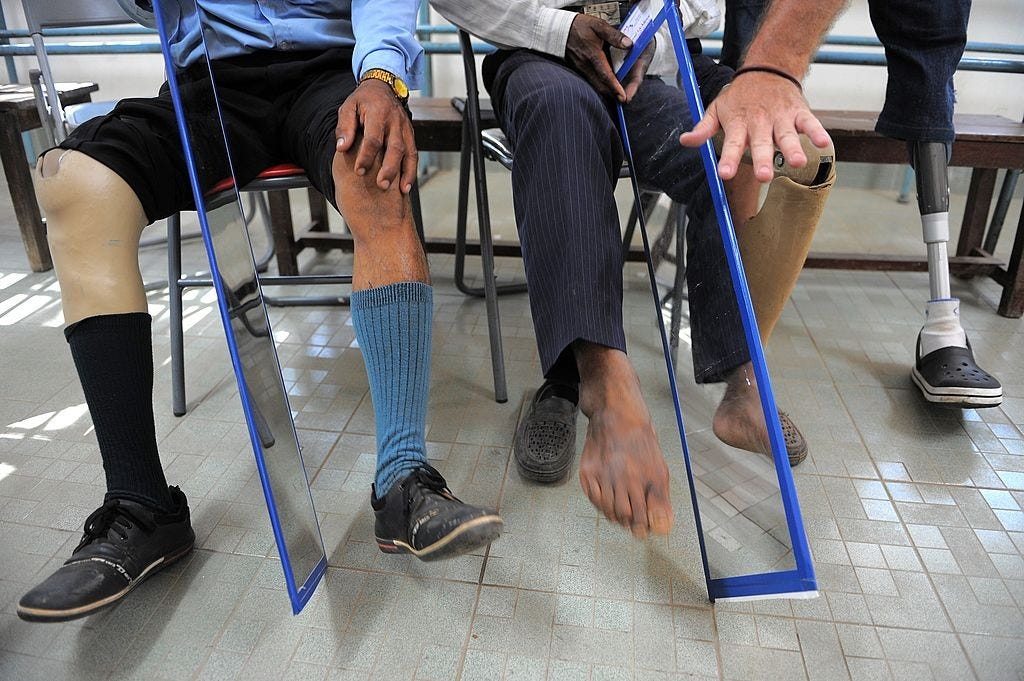
He sought the help of V.S. Ramachandran, a neuroscientist at University of California San Diego who has done research showing that when a mirror is placed so that it reflects the other limb, it creates an illusion that the amputated limb has been restored and provides relief. But the relief sometimes only lasts as long as the mirror is in position. Lin wasn’t responding to pain medications, and decided to try psilocybin mushrooms, which he had heard anecdotally could help. In a case study from 2018, Ramachandran, Lin, and their colleagues reported that the combination of mirror visual-feedback and psilocybin led to “a striking and long-term reduction of pain.”
Lin’s success was just a case study. To figure out if psilocybin can help others with phantom limb pain, neuroscientist and professor of anesthesiology at UCSD, Fadel Zeidan, ran a small study in nine more amputees; five received psilocybin and four received niacin as a placebo. The trial’s goal was primarily to show that it’s safe to give psilocybin to amputees, yet the preliminary results were promising: those who received the drug experienced a 50 to 75 percent reduction in pain. Zeidan recently received a grant from the National Institutes of Health to do a clinical trial with a larger sample size. The Microdose talked to Zeidan about his initial study, and how he thinks psilocybin reduced this mysterious kind of pain.
How did the research on phantom limb pain and psilocybin begin?
Albert Lin is a professor and a National Geographic Explorer. He got into a really bad car accident, and they had to amputate his leg because he had an infection. This super active dude had crippling phantom limb pain, which is pain that emanates from a limb that’s missing; it feels like the limbs are basically being severed. Physiologically, it really makes no sense. It might be related to trauma, where the organism’s safety signal pain is still saying, ‘Hey, there’s something wrong.” Albert went to Joshua Tree with his girlfriend, took a massive dose of magic mushrooms, and after working with Ramachandran here with a mirror box, brought a mirror to the desert and coupled his psychedelic experience in Joshua Tree with the mirror. It essentially eradicated his pain. A case study was published on that, with a sample size of one.
My first talk at UCSD eight years ago, Albert was in the audience, and I had just come from North Carolina at Wake Forest University. He approached me after about my work on [the neuroscience of] meditation and asked me if psychedelics work on the same biological processes. After I looked around and saw there were no cops in the room, I said, “Yeah as a matter of fact, I think they do.” Because they both likely target mechanisms supporting egocentric appraisals of experience. He invited me to meet a bunch of other psychedelic researchers that had been in the underground that were working with rodents. And they got a gift from a philanthropist to study phantom limb, and we were able to carry out that work. It kind of fell in my lap.
I had heard of the mirror techniques to alleviate pain—do you think the psilocybin is enhancing its effect or doing something on its own?
Great question. I don’t know. Albert believes that the mirror was critical, and we had this dilemma: do we do this with the mirror? I didn’t want to because we still didn’t do the first pancake study, we don’t know the effects of psilocybin alone. I love Ramachandran’s work but the mirror box isn’t sustainable. It’s so cool how it works. It basically creates this illusion that your limb that’s missing is intact, which can give this exhale that tells this aberrant signal from the organism that it’s actually okay. But that’s not the truth. There is currently no cure for phantom limb pain. Mirror box has an immediate phenomenon, and perhaps coupled with the truthfulness that psilocybin can elicit, it can be uniquely efficacious.


For the small study you’ve recently completed, as you said you didn’t use a mirror. What were your results without it?
We did a phase zero basically, a safety study, of five people versus four. We did 25 mg psilocybin versus 100 mg of niacin. The main question was: is psilocybin safe for people that have amputations and phantom limb pain? And we did functional MRI before and after. We screened them, we scanned their brains, did pain assessments, we prepped them for three days, and we dosed them. The day after, they did integration. They had eyeshades and music. Not too far off from the Hopkins model, but I think we have a cooler playlist. Then we collected data two and four weeks post-dose.
We found it was very safe. In fact, the niacin group had higher blood pressure increases than the psilocybin group. In our world, 30 percent improvement in pain is considered clinically significant. And after four weeks, there was a 70 percent reduction in phantom pain. Mind you, nothing works for this disease. The same was true for residual limb pain, pain that emanates from the stump. And one of my favorite findings is that on the Brief Pain Inventory, the classic standardized chronic pain assessment, from two weeks and four weeks after the dose you can see a beautiful staircase effect. So the psilocybin is still doing its thing after the dose.
When we ran fMRI analyses, we found a greater deactivation of the thalamus, which is a central component of pain processing, and the default mode network, where there are self-referential processes. In the primary somatosensory cortex, we saw a lot of activity there too. This is a major player in phantom pain because the sensory cortex reorganizes itself to facilitate the experience of phantom pain. What we saw was that the greater the brain activity there—and perhaps reorganization rehabilitation—the greater the pain relief four weeks out. That’s the study, more or less. And three weeks ago, we landed a $4 million grant from the NIH to carry out a properly powered trial.
How do you think psilocybin reduces the pain?
As a physiologist, it doesn’t make sense that there’s pain that’s coming from an area that’s not there. Perhaps the method is to treat a hallucination with a hallucination, to push the control, alt, delete, restart buttons that allows the system to say, “Oh, we’re not in danger right now.” The brain processes that were borne out—again it’s a small sample, and I shouldn’t be over-interpreting them— suggest that there is an interaction between self-referential, low-level nociceptive input and higher level somatosensory interactions that are remediating the pain. It’s not a silver bullet. There are multiple components that are interacting with each other.
Interestingly, all of our patients said the therapists were really important, and the prep and the integration was critical. And—this was surprising to me—almost all of them said they wouldn’t have done it if it wasn’t in a clinical setting. They were stoked that they were in a clinic with a physician next door, and an ER half a block away.
Has this made you think differently in your treatment of pain for other conditions, not using psychedelics?
Yes and no. What I’ve learned from studying meditation and chronic pain, is that we have a situation in the United States where patients come in and they want their pain to go away. Physicians take that upon themselves, and say, “I’m going to remove your pain.” Let’s do surgery. Let’s do spinal cord stimulators. Let’s give you opiates. Whatever we do to remove your pain,—it’s not about changing the relationship you have with your pain. Chances are, that pain may be there forever, and the patient will start blaming themselves. I’m still in pain. It must be my fault.
What we’ve seen in our mindfulness research is that some folks still feel the pain, it just doesn’t bother them anymore. They’re not attaching this sense of, “This is who I am, I identify as a patient living with chronic pain” anymore. They find a way to integrate their moment to moment experience where the pain doesn’t contaminate it.
I feel like psilocybin can do the same thing. It can change and modify egocentric appraisals of arising nociceptive input in a way that changes the relationship one has with that experience. They can still move on with their day to day life without it becoming a self identity that dramatically worsens the feeling of pain.
This interview has been edited and condensed for clarity and length.
