

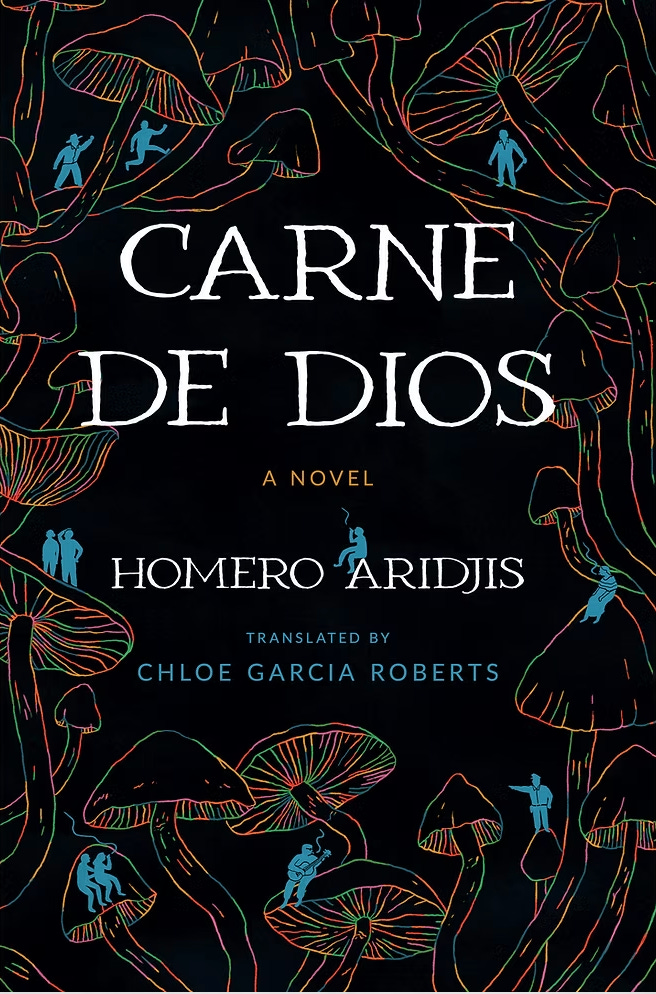
The following is an excerpt of my translation of the novel Carne de Dios by the Mexican poet and novelist Homero Aridjis. Carne de Dios, “God meat” in Spanish, is a translation of Teonanácatl, the Nahuatl name for a species of psilocybin-containing mushrooms native to Mexico. Homero Aridjis’s novel Carne de Dios is the story of how these mushrooms came to spark the subsequent consciousness revolution of the 1960s, unleashing a wave of global interest in mushroom culture that is still going strong today. It is the story of how and where it all began, high in the Sierra Madre de Oaxaca mountain range, in a tiny mud-walled shack overlooking the remote town of Huautla de Jiménez, where a Mazatec single mother named María Sabina lived with her family and practiced as a healer using the sacred mushrooms.
María Sabina lacked a formal education, did not know her own age, and never learned to speak Spanish. She discovered her ability to heal with the sacred mushrooms as a child and performed mushroom ceremonies, or veladas, throughout her life. She achieved international fame in her sixties after the American banker and amateur ethnomycologist R. Gordon Wasson and his wife, Valentina Wasson, published accounts of their participation in one of María Sabina’s veladas in This Week and Life magazines. These articles brought about a flood of pilgrims from the United States and Europe. Rock stars, writers, businessmen, scientists, politicians, poets, beatniks, and seekers of all kinds flocked to the tiny town of Huautla to meet María Sabina and attend one of her ceremonies (Allen Ginsberg, Bob Dylan, Jack Kerouac, Juan Rulfo, and even John Lennon make appearances in the story).
The author of the novel Carne de Dios, Homero Aridjis, was born in Contepec, Michoacán, and is one of Mexico’s foremost living writers. Aridjis has written fifty-one books of poetry and prose over his life and has won many important literary prizes including the 2024 Griffin Poetry Prize. Formerly Mexico’s ambassador to Switzerland, the Netherlands, and UNESCO, he is also the president emeritus of PEN International and the founder and president of the Group of 100, an environmentalist association of artists and scientists.
In Carne de Dios, Aridjis centers María Sabina as both the vital source of the global interest in these mushrooms and their medicinal and psychological potentials, and as one of the greatest healers, poets, and visionaries that Mexico has ever produced. The following excerpts are chapters from his novel. The first, “A Dark Night,” is an account of one of Sabina’s veladas, with a description of the ceremony, her songs, and her home. The second, entitled “John Lennon,” is part of a chapter that explores the renowned rock star’s rumored pilgrimage to Huautla, Sabina’s hometown, to find her.
A DARK NIGHT
Visitors arrived at María Sabina’s house by following a dirt road. They crossed cloud banks on their journey through the mountains, where sorcerers and spirits were visible in the changing forms of the clouds. Plants without roots floated in the air. The velada was held on a Thursday. A table altar was pushed back against a wall and draped in a cloth covered with embroidered flowers and birds. An oil lamp illuminated San Pablo and San Pedro and a Virgen de Guadalupe. Dried corncobs hung from the roof like amber stalactites. Next to a pot of copal were coffee beans, cacao beans and corn, macaw feathers and fourteen pairs of mushrooms in two lines of seven.
Out there over the mountains, the mists swallowed the half moon. Underneath, Huautla dissolved into the darkness. The mycologists came up from Cerro del Fortín. Outside the shack, hens chattered, roosters clucked. A turkey covered in carbuncles that spilled from his head to his breast seemed to interrogate the foreigners. They wanted to slip past him into the shack, but a hog grumbled. Inside, in the space for the rite, the final rays of light pierced the cracks in the door.
“We smoke the day. We smoke the heart of God.” María Sabina exhaled as she greeted Gordon with a cigar in her mouth.
“It’s cold.” Apolonia put a black clay pot of atole to heat on the stove. A little girl embraced her legs. Wrapped in a rebozo, the little one listened to her mother sing all night.
“How old is she, señora?” asked Richard Stevenson, camera in hand.
“I don’t know when she was born. None of my ancestors knew their ages. All I know is that my mother, María Concepción, told me that she was born in Río Santiago, the municipal center of Huautla. My father, Crisanto Feliciano, who wore a cotton shirt and short pants, died from being transformed into a turkey. The shamans and the healers could not save him. With his neck covered in red bumps and a fleshy flap of skin hanging like jowls, he departed. We suffered greatly because he left us with nothing.”
At that moment Gordon’s daughter and wife, Ivanna and Tatiana, arrived.
“What will see in the velada, señora?” asked the professor Roger Hofmann. He was bald, with glasses, in his fifties, and he carried a leather messenger bag for the mushrooms.
“Marvels in the dark. Sometimes you can see the Hombre de las Montañas. ¡Tso! But you shouldn’t photograph him,” she warned Stevenson.“¡Tso! Brilliant like the day is the master of the fields. Mounted on a white horse, he wears his hair gathered over the forehead in one golden lock. ¡Tso! Like the mist. ¡Tso! Like the air. ¡Tso! Like the mind,” said María Sabina, as translated by the teacher Miss Herlinda.
The foreigners had arrived to Huautla a few days before, deposited at the terminal by a bus. They were boarding with the town teacher but were so eager to learn the secrets of the mushrooms that they didn’t want to miss any of the shaman’s movements. Not even one word. Their ignorance of the Mazatec language, her language, was no impediment as her exalted, enigmatic, and elusive singsong voice transported them to the world of the Holy Children. She administered them in pairs, male and female, as the mushrooms had a sex and if it was not respected, one could have a bad trip. Local mushroom foragers helped with the ceremony. A healer, a mule driver, the priest of the church of San Juan Evangelista, and the mayor were all lying there on mats, hungry for visions. And she, with invocations to the saints, rooted the sickness of fear from out of their guts. She became impatient when the spirits didn’t respond to her calls. Rhythmically she spoke,“¡Tso, tso, tso! Mhmmm, hmmm, hmmmm!
I am the woman who arrived
I am the woman who will arrive
I am the woman who was present I am the woman who is present”
Kneeling on a serape, the holy fool summoned the Trinity and the saints. She took mushrooms out of a cardboard box, shredded them, and divided them into clay cups. Lit by candlelight, inhaling the copal smoke, and chewing the mushrooms, she hummed something incomprehensible, something that shifted and became a song. Calm, as if the words rose from ancestors invisible to the ear or eyes, she let herself be carried by the rhythm of the litany. She hovered above herself, identifying herself as “the woman who sees below the water and behind things” and “the woman who suffers.” Through the ritual she transformed into the priestess of the mushrooms. Her shadow on the floor parted from her body.
I am a woman creator
I am a woman star
I am a woman moon, a woman sky
I am woman dew in the grass
“The Holy Spirit descends to the altar. The eldest mushroom forager is transported there where God is. The eye that feels and thinks behind closed eyelids, the eye that is separated from the body, melds with space; it sees everything without seeing anything. The mushroom speaks,” the teacher Herlinda translated the words of María Sabina. The shaman accentuated her silences and facial expressions with her hands. The ancient Teonanácatl, the God Meat, by means of the trance turned her eloquent, allowed her to cure sickness and create visions.
Under the influence of the Holy Children, María Sabina clapped and danced.
I am a woman who looks toward the inside
I am woman light of day
I am woman morning star
I am woman god star
She held the silence for several moments. Later, with a strange shining in her eyes, she took up her song again:
I am a woman who yells
I am a woman who whistles
I am a woman who thunders
I am a spirit woman

JOHN LENNON
Day after day the beatniks began arriving to town. At dawn you would see them crossing the fields, sitting on rocks, or sticking their heads up above the brush like aliens. At dusk they wandered all over the streets smoking marijuana, chasing off the scavenging vultures, or reciting poems to the cornstalks. They walked through the main street with mushrooms wrapped in banana leaves, or rags, or newspaper, but the stalks and caps of the hallucinogens stuck out. Those who feared that the police would confiscate them would hide the mushrooms in their clothes. They carried them with veneration, as if at any moment they might come to life and talk to them.
Some walked along the edge of the river stamping on the dry leaves; others stretched up to pick oranges off the branch. Still others just wandered from place to place, like they were in a road novel, without any fixed direction. After long sojourns they would end up returning to the exact same spot on the rough path they had taken at the outset. You would see the women at the store buying Delicados cigarettes, a kilo of coffee, or soft drinks to quench their thirst. Or you might come upon them in the cornfields making love.
Philip liked to look out from the small window of his room in the Hotel Grande to the vista of the mountain range, where he was equally dazzled by the afternoon sun or the reflections in the river water. It made him happy to turn his gaze to Cerro del Fortín and an unspecified meeting with María Sabina, to freely wander through that green labyrinth to the ceremony of revelation, where he would be welcomed as a participant, though it may have begun and ended without him.
As for John Lennon, a few of the locals swore they had seen a young man in sunglasses covering his head with a yellow wig that glowed in the night. Others testified they had run into a poor musician who had traveled to Huautla to visit María Sabina, but they didn’t know where he had been staying. A local reporter believed it couldn’t actually be John Lennon, but instead was a vision of the god Tezcatlipoca pretending to be the musician.
The teacher Herlinda Martínez Cid said she’d run into him in a bakery buying Oaxacan black bread. Miss Pike asserted that the rumored musician had not actually come to town; it was just a vagabond rocker. The man in question was a crazy person that talked to himself and smoked marijuana. She had seen him once in the middle of the night on the main street walking in the rain, his clothes and his sunglasses dripping. Naked under his raincoat, he had exposed his genitals to her.
María Sabina remembered that a foreigner had once appeared at her house in dark glasses, behind which she could not see his eyes. She had run into him earlier lurking around Cerro del Fortín looking for a velada at twilight, because he was awake at night and spent his days sleeping. Her daughter Apolonia said that she had heard someone at the door of her shack humming “That’ll Be the Day” but she didn’t know who it was.
Richard Stevenson, looking for him in all the hotels in town, had confirmed that no John Winston Lennon was registered at any of them. And a waiter was sure he’d seen an English musician in his twenties, without a nickel to his name, who was so argumentative that at the slightest provocation he began spewing insults. The man never changed his clothes, but sometimes he would appear wearing a shirt of surprisingly brilliant white. So dressed, he would go out to walk through the deserted streets or the coffee plantations until dawn. The breasts of the woman who was with him were always escaping her clothes. The musician, because of his mercurial temperament, was called “the Look Don’t Touch Man.” An employee remembered that one morning that same John started to sing a song in English, slapping a seemingly unbreakable Gallotone guitar with his hands. But he broke it. He mentioned that in the corridor of the hotel he found him making out with his English girlfriend, the same Cynthia, that nymph with the habit of taking nude moon baths or stripping down in the underbrush.
“The morning he left he looked at me standing in the lobby ready to carry his luggage. As if I was an orphan, he told me: ‘Fathers aren’t gods, they’re the sons of wretches.’ And then he went down into town, while Cynthia told the taxi driver to follow him along the main road and, if it was OK, to take him first to Puebla and then on to the international airport,” remembered the employee.
Following in the footsteps of the absent one, Richard Stevenson photographed the room, the restaurant, and the hallway where there were signs of his presence. He took a photo of the graffiti scratched on a glass door: “We live in a world where we hide to make love and commit violence in the light of day.”
Supposedly John Lennon had left a note about a velada with María Sabina on the rickety bed. Stevenson photographed it:
I am a coffin that walks.
My vision emanates from my ashes.
The voice of the cacti in the hills is mine.

Excerpt of Carne de Dios by Homero Aridjis. Translated by Chloe Garcia Roberts. Published by The University of Arizona Press. Copyright 2025.
 | A guest post by
|