

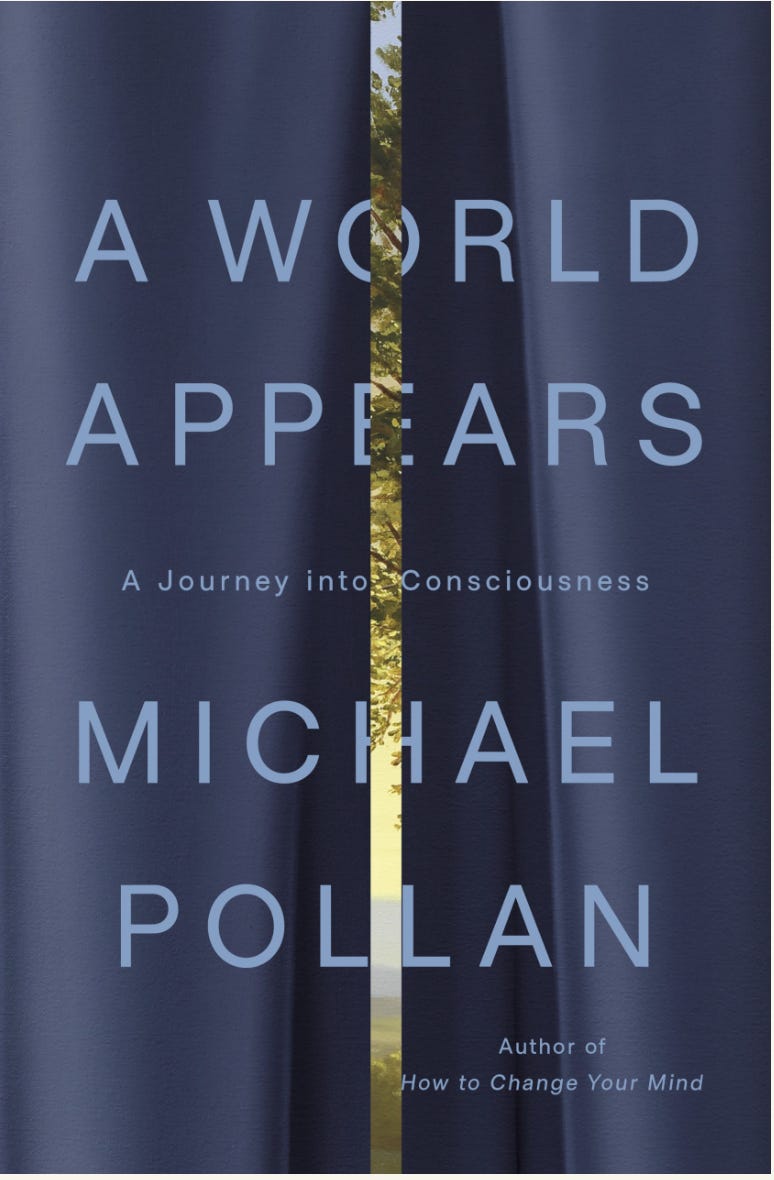
Below you’ll find an excerpt of my new book A World Appears which was published last week. This book consists of my explorations into four different dimensions of consciousness, beginning with its earliest manifestation in nature and ending with its more complex and rare creation: selves like us. Except for a brief period in my teenage years when I was reading Hermann Hesse, writing bad poetry, and thinking about the Big Questions, I never gave much thought to consciousness. What pushed the question front and center for me were a couple of psychedelic experiences I had in my fifties and sixties. This is a section from the first chapter of the book where I’m focusing on the question of whether plants are sentient.
How widespread in nature is consciousness? Descartes believed it began and ended with Homo sapiens, but today there are few scientists who accept his claim of a human monopoly. A great many mammals, several bird species, and octopuses are now generally thought to be conscious, and there are scientists and philosophers who believe that some rudimentary form of consciousness, or sentience, reaches much further, all the way to insects and, possibly, beyond the animal kingdom.
Most attempts to understand consciousness begin with human consciousness, which is surely the most challenging case. Not only is there the self to deal with, but there is also the fact that we humans are, or can be, conscious of being conscious—we have metaconsciousness, adding a whole other layer of complexity. Then there is the role of culture and history in the shaping of human consciousness; consciousness in the West in the twenty-first century is different in important respects from consciousness in other cultures at other points in time. It’s little wonder that the phenomenon of human consciousness can seem to us so far removed from the rest of nature.
Yet we can assume that human consciousness is, like everything else in nature, the product of evolution, even if we have trouble imagining exactly how that came to be. So what if we begin our inquiry at the far end, down near the bottom of the tree of life, long before the emergence of nervous systems, and go in search of consciousness in its simplest form? How early in the history of life do we start to see something we might call protoconsciousness, or sentience—a way of being in the world that might, by steps, evolve into something as elaborate and complex as human consciousness? My wager is that by starting there, deep down in the natural world rather than up here in our highly unusual heads, the hard problem might yield, or at least become a little less hard.
Let us begin, in fact, with a class of beings that few would regard as sentient, let alone conscious. The creatures I have in mind are ancient, brainless, and largely immobile—hardly the most promising candidates for consciousness.
Let us begin with plants.
In the long history of our species, we moderns in the West are the exceptions in our reluctance, at least as adults, to grant the spark of subjectivity, or personhood, to the wider nonhuman world. So how did we get to be so stingy in our granting of consciousness to other beings? “Science” is the easy answer, but a particular conception of science with a particular history. Galileo, Descartes, and Locke, who together set forth the terms of the modern scientific enterprise beginning in the seventeenth century, did so in such a way that it was bound to disenchant the nonhuman world. It was Galileo who divided the world in two, a move that English philosopher Alfred North Whitehead called “the bifurcation of nature.” One part of nature consisted of “primary qualities,” such as size, shape, mass, motion, and number, all of which are objective, measurable properties of material things. The other part of nature consisted of “secondary qualities,” such as color, taste, smell, sound, and warmth or cold, which are subjective and difficult to measure.
Wisely, Galileo determined that the scientific enterprise would achieve the most, and antagonize the Church the least, if it confined itself to the study of primary qualities—the measurable material world, which is to say, quantities. But if the “grand book of the universe” is written in the language of mathematics, as Galileo proposed, then how do we deal with all those “secondary qualities” of reality that aren’t mathematizable—the redness and sweetness of an apple, for example? Galileo solved this problem by, in effect, reconceiving reality as comprising only those characteristics that could be quantified and expressed mathematically: size, shape, mass, motion, and number. He effectively evicted from the world all other qualities—color, taste, scent, and so forth—and relegated them to the minds of the human beings perceiving them (as if those minds weren’t part of the world!). Through Galileo’s lens,what we experience as the color red is “really” a specific frequency of light, and sweetness is “really” a kind of molecule, such as sucrose or glucose. No wonder we have such trouble incorporating consciousness into our scientific picture of the world or detecting it in other beings. Science has been constructed in such a way as to exclude it or treat it as an illusion.
Descartes divided the universe along more or less similar lines: There was res extensa (matter stuff) and res cogitans (mind stuff), the possession of which he limited to humans. This division gave Descartes the green light to perform vivisections—dissections of live animals, including in his case rabbits and dogs—as his philosophy convinced him that animals, lacking souls, couldn’t possibly feel pain. As for the shrieks and howls of the creatures he tortured, these he dismissed as the meaningless noise of automatons, having nothing to do with feelings as we—and only we—know them.
As a matter of methodology, the bifurcation of nature has proved wildly successful. It allowed the scientific enterprise to flourish and kept some number of scientists from being burned at the stake for challenging Church orthodoxy. By training their attention on the quantifiable material world and leaving subjective experience off the table, science and technology were able to achieve more than Galileo or Descartes ever could have dreamed. As it turned out, there was quite a lot we could do with mathematics.
But it didn’t take long before what began as a method morphed into a metaphysics. The quantifiable material world became the only one that counted, and the reality of lived experience faded before the power of mathematical abstraction. This wasn’t entirely Galileo’s fault—he never doubted the existence of qualities; he just chose to treat them as properties of the mind (a.k.a. the soul), best left to the purview of the Church. But his intellectual descendants came to mistake the map he’d given them for the actual territory. And nowhere on that map could subjective experience be found. Stripped of qualities, the material world was reduced to quantities and, eventually, to a “resource.” We know where that has led.
And yet even as science was busily objectifying the world, the reality of subjective experience couldn’t be denied—or reconciled with matter. Descartes rightly observed that there is nothing of which we can be more certain than the reality of our first-person experience. Enter dualism and the mind-body problem—the idea that there are two completely different and irreconcilable kinds of “stuff,” one mental and the other physical. This idea is still very much with us, vastly complicating our efforts to understand consciousness and somehow root (or reroot) it in nature. There may have been good reasons for bracketing consciousness, and much to be gained by doing so, but along the way, science learned to gaze upon nature and detect no sentience. Indeed, at some point, science stopped looking for it. This lacuna owes to what philosopher Evan Thompson and his coauthors, physicists Adam Frank and Marcelo Gleiser, call Western science’s “blind spot”—its failure to take lived experience, or phenomenology, seriously. The blind spot (which is the title of their 2024 book on the limitations of the scientific method) has made it difficult, perhaps impossible, for the physical sciences to reckon with consciousness. There is a large irony here: By subtracting subjective experience from “the real world,” five hundred years of reductive science and philosophical dualism have inadvertently elevated consciousness, unmoored from nature, into something very much like magic.
So what might we discover if we take seriously the idea that some very simple form of consciousness—let’s call it sentience—is actually widespread in nature?

I should say at the outset that on the afternoon I began to take this idea seriously, I had eaten a handful of magic mushrooms. I mention this not because I’m eager to undermine my credibility but because I’m curious about the value of insights like this, ones that owe their inspiration to altered states of consciousness.
One of the more consistent and curious aspects of psychedelics is their ability to reanimate a world gone quiet and still. Researchers at Johns Hopkins have found that a single psychedelic experience dramatically increases the likelihood that a person will attribute consciousness to other entities, both living and nonliving. Among the entities mentioned in the study, plants saw the greatest increase in conferral of consciousness: Before their psychedelic experience, 26 percent of participants believed plants to be conscious; afterward, this figure climbed to 61 percent. (Fungi were not far behind.) Another study, this one done at Imperial College London, found that psychedelics altered people’s fundamental beliefs aboutreality, shifting them from materialism toward panpsychism or idealism—toward a world steeped in mind.
Who can say what this means? It could simply be that psychedelics soften our resistance to various forms of magical thinking. Or perhaps the attribution of consciousness to other beings is an innate cognitive bias that gets drummed out of us in school. Is the belief that all beings are conscious more or less adaptive than the belief that we humans are unique in this regard? If we err on the side of mistaking that shadowy boulder for a lumbrous bear rather than the other way around, we are more likely to survive. (Hyperactive agency detection is the technical term for this adaptive bias.) Conversely, the idea that the rest of the world is more or less dead (thank you, Western science) has given us license to exploit nature without limit in ways that have advantaged us, though only in the short term. Right or wrong, the dead-world idea has helped the West prevail over traditional cultures that believe the world is alive with consciousness. And yet because we have acted based on this belief, we are well on the way to destroying the world, or at least our own habitat, which is surely not to our advantage. The question, then, is this: Does the animism that psychedelics appear to promote represent a return to forms of magical thinking we have outgrown? Or does it represent a relearning of something crucially important about the world that we have, to our peril, forgotten?
In his writings on mysticism and religion, William James urged us not to rush to judgment on such questions. He collected reports of extraordinary experiences—accounts of divine encounters and previously unseen worlds—and rather than dismissing them, he proposed treating these mystical episodes as intriguing hypotheses to be tested instead of ignored. Ultimate truth in these realms being impossible to establish, the proper test for James was the pragmatic one: How useful would it be to treat these perceptions about the nature of reality as true? What would it get us?
That afternoon in my garden, after ingesting the magic mushrooms, I was as certain of the sentience of the flowering plants around me as I had been of anything up to that point. (James knew all about this certainty; he called it the “noetic quality” of the mystical experience.) Eyeless, the plants nevertheless “returned my gaze,” I wrote afterward, and gave the distinct impression that they wished me (their gardener!) well. To be clear, I didn’t think these plants possessed the sort of mind that could reflect on experiences and form opinions; I didn’t imagine them to have interiority. But these beings were definitely awake and, in their own plantlike way, watchful. What they exhibited, I felt sure, was some elemental sense of being alive and aware. This sensing came in two flavors, or valences: a positive one when, say, the late-afternoon sunlight bathed their outstretched leaves, and a negative one when, for instance, those leaves were being chomped on by insects. It seemed obvious that not only were these plants cognizant of their environment, but they also had preferences, agency, and a viewpoint of their own.
Now, with the psilocybin molecules long gone from my brain, my doubts about plant consciousness have returned—the same doubts most people have, assuming they’ve ever stopped to consider the matter. Most of the time—which is to say, when I haven’t taken drugs—plants don’t seem conscious at all to me. They return to their accustomed role as the mute, immobile furniture of our world, the green backdrop against which the livelier (and likely more conscious) lives of animals play out.
So which lens yields the more accurate picture of reality? Why are we more willing to ascribe consciousness to animals than to plants? Because they have nervous systems like we do is the usual answer. But are brains a prerequisite for consciousness? Not according to the scientists who subscribe to integrated information theory or to the philosophers arguing for panpsychism or to the computer scientists building artificial intelligence. All are agnostic about the “substrate”—the material basis or hardware—necessary to host a conscious system; it need not be a brain. In fact, neuroscience has yet to identify the biological structures necessary to generate consciousness. We just take it on faith that these will be found and that when they are, they will be found in the brain.
As proud possessors of said brains, we are naturally cerebrocentric. But do we really think that when we find intelligent life elsewhere in the universe, these conscious beings will necessarily come outfitted with moist gray brains like ours? That seems unlikely. Even back here on Earth, there’s an abundance of research (as we will see) showing that brains don’t in fact hold a monopoly on memory, awareness, cognition, agency, and decision-making. So why should we grant them a monopoly on sentience?

Excerpt of A World Appears: A Journey into Consciousness by Michael Pollan published by Penguin Press. Copyright 2026.