

My interest in psychedelic toads began in 2020, when I found out that they were being targeted by poachers in the Sonoran Desert. What a strange and crushing dissonance! The world’s only known psychoactive animal, a marvel of evolutionary biology, was seemingly under threat due to demand for its secretions, which commonly elicited divine experiences for the people who smoked them. I began reporting on this niche wildlife trade and got sucked into a far bigger story—about the search for transcendence and what it can cost—that eventually became a book, The Ego Trip: Psychedelic Toads, a Trail of Deaths, and the Guru Who Peddled Transcendence, which publishes tomorrow. Some questions recurred throughout. What does it mean when spiritual experience becomes available in the form of a product? When people on psychedelics get the sense that everything is connected, what might be hidden from sight? This excerpt is from my chapter about the dystopian market for “toad medicine”—my doorway into the entire project. If you read nothing else, please consider this: the same trip is available without harming any toads. Just use synthetic 5-MeO-DMT.

In 2014, the conservationist Robert Villa—soon to become the world’s foremost defender of psychedelic toads—paid a visit to the Yaqui, an Indigenous community in the Mexican state of Sonora. The tribe was facing an array of environmental threats, including the construction of an aqueduct that would drain the Rio Yaqui, historically one of the few perennial rivers in the region. Representatives had filed legal challenges and, when these were disregarded, began protests that included blockading the state’s main highway. The backlash was swift and violent: kidnappings, burned cars, homicides. Mexico was on its way to becoming the world’s most dangerous nation for environmental activists; in 2021, an activist was murdered every week, on average. Amid this spreading tumult, Villa learned on his visit, a new and unsettling economy had taken root in Yaqui territory: the large-scale collection of Sonoran Desert toads.
Toads, known in Yaqui language as boboc, feature prominently in the tribe’s mythology. In one story, Toad borrows the wings of a bat to fly up into the clouds, where he tricks the Rain King into ending a devastating drought; in another, he brings fire to the tribe after stealing it from the gods and carrying the flames in his mouth. The Yaqui would decorate Sonoran Desert toads with ribbons and parade them ceremonially, praying for rain. In a far cry from this exalted status, toads were now being caught en masse for the psychedelic market, where they were prized as a source of 5-MeO-DMT, a powerful and fast-acting compound also known as “the God molecule.” In one instance, or so the rumors went, a truck had been discovered carrying two tons of the animals.
Villa related this all to me the first time I called him, back in 2020, after several stories had quoted him raising the alarm about toad poaching. He introduced himself on the phone as a “freelance naturalist” and told me that he owned two Gila Monsters—a giant lizard with black and orange scales—in addition to a Sonoran desert tortoise named Virgil, whom a family member had given him at the age of five. He later acquired a pet gopher snake and took it along to catechism classes. He became especially fond of sea turtles. In middle school, on his first day of orchestra practice, both Villa and his teacher were wearing turtle T-shirts. She introduced him to some herpetologists, who became Villa’s earliest mentors.
Like the tortoise, Villa is now in his mid-thirties. He is small and puckish, with deeply tanned skin and a shock of black hair that he tidies into a topknot. He is a masterful violinist, even though he stopped taking lessons when his parents could no longer afford them. With his striking looks and eccentric interests, he is like a character dreamed up by Wes Anderson. In the summer of 2023, when I visited him during an Arizona heatwave, we went to an arthouse cinema to watch Anderson’s latest film, Asteroid City. At one point, a singing cowboy made a throwaway remark about a “toad swindle,” and Villa turned to me with an expression of delight.
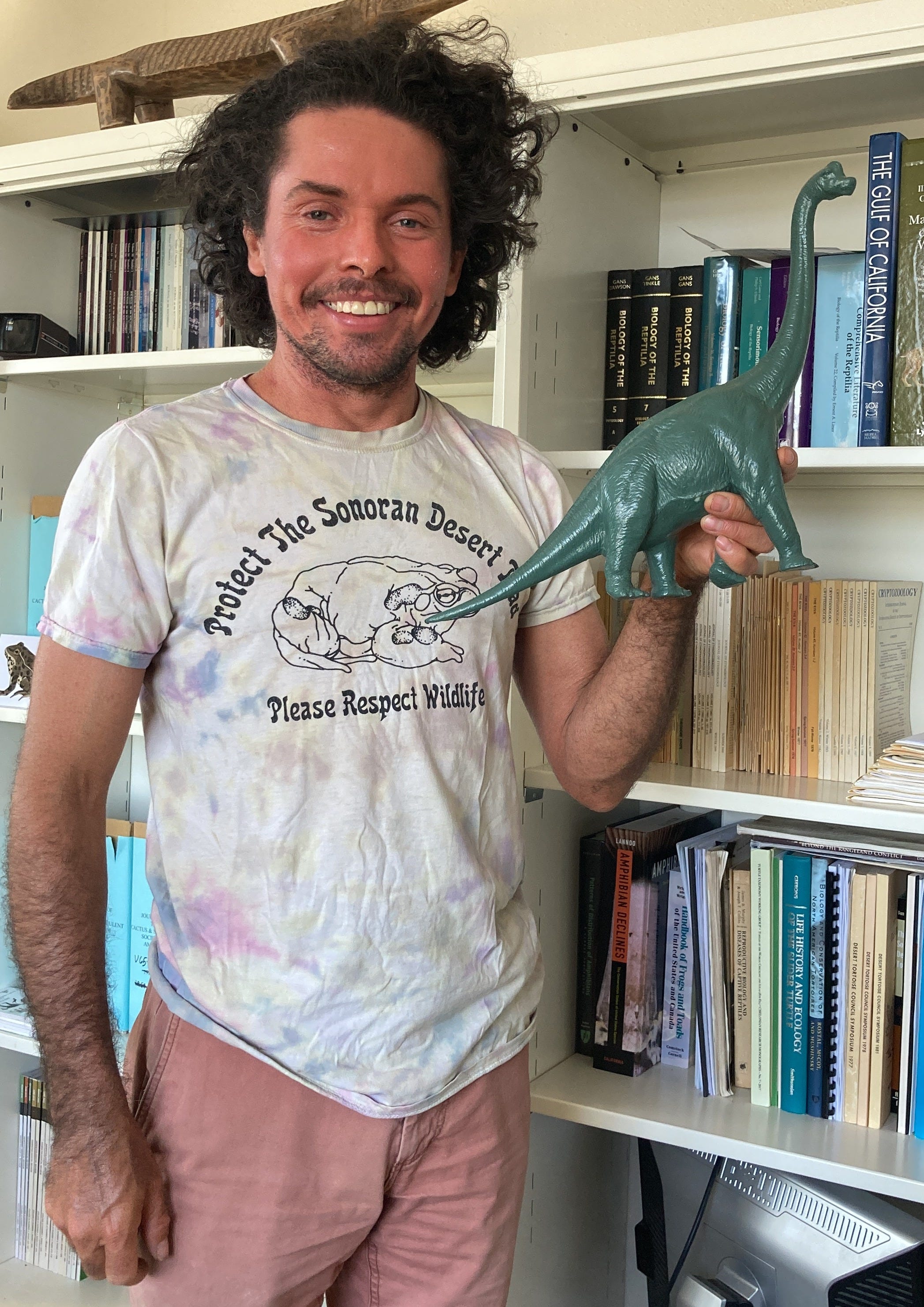
A few years after his visit to Yaqui territory, Villa appeared in a VICE documentary about the toads, speaking about their natural history. Villa saw the flood of interest as deeply concerning—“a cognitive dissonance with the wellness motifs of the psychedelic renaissance,” as he later wrote. It was difficult enough to control demand for wildlife products with more tenuous therapeutic effects, like rhino horn. What hope could there be for an animal that delivered genuine states of transcendence?
Amphibians are the most imperiled group of vertebrates globally, with around forty percent of the approximately 8,000 known species threatened by extinction. The outlook is especially bleak in Mexico, where habitat loss, climate change, and diseases like the chytrid fungus have already caused devastating losses. Villa had heard of Sonoran Desert toads—which reach the size of small chickens—vanishing from certain areas. He worried that overexploitation would drive further declines without anybody paying attention. Not long after the VICE episode aired, he met a Tucson artist who wished to print a satirical Nike tee-shirt featuring a Sonoran Desert toad and the words, “Just Smoke It.” Villa urged him to publicize risks to the species instead. To raise awareness, he and the artist collaborated on a new design. “PROTECT THE SONORAN DESERT TOAD,” the shirt read. “PLEASE TRIP RESPONSIBLY.”
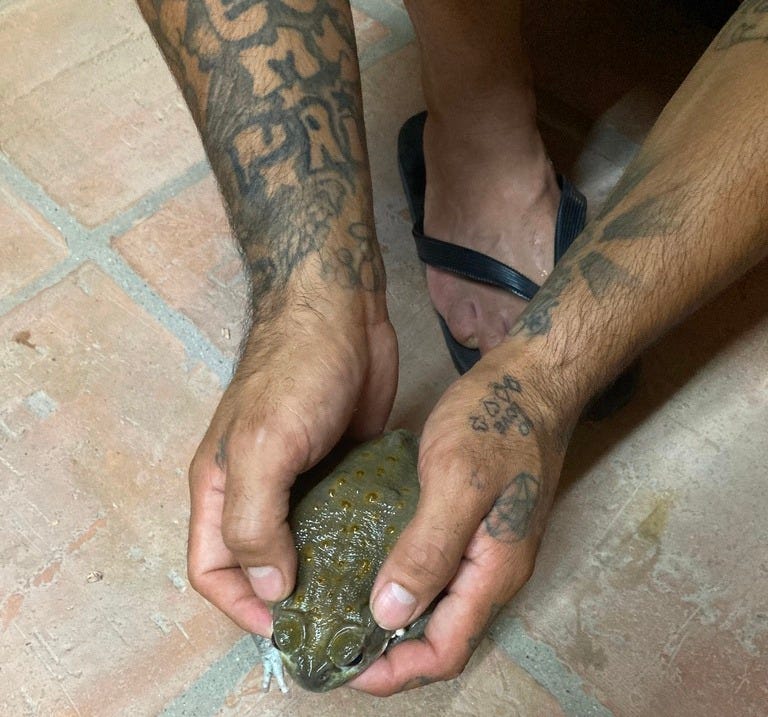
Villa wasn’t the first to sound the alarm about Sonoran Desert toads. Albert Most himself—the first documented toad smoker in history—had shared a cautionary fable from Aesop: “A certain man had the good fortune to possess a goose that laid a golden egg every day. But dissatisfied with so slow an income, and thinking to seize the whole treasure at once, he killed the goose.” Shortly thereafter, toad smoking was described as “an ethically dubious trip” in The Entheogen Review, an underground newsletter about psychoactive substances. Its editor had kept four of the animals in a terrarium for a while but given up milking them. “In extracting the venom one creates a lot of fear and stress in a fellow creature,” he explained. But in 1994, the arrest of a California schoolteacher on toad smoking charges set off a media frenzy, bringing new attention to the species. “Alas! Alas!” the Entheogen’s editor lamented. “The distorted publicity has now made it a hip thing.” A reader from Arizona wrote in to express dismay about the “harm or decimation” that might result when “all the unhappy hordes pursue another way to ‘get off’ at the expense of the toad.”
Through the deep passage of evolutionary time, Sonoran Desert toads have proved extraordinarily resilient to change. Fossils of their skeletons have been discovered alongside anteaters, camels, mammoths, ground sloths, capybaras and other creatures that once roamed a lusher, greener region. Despite its ancient appearance, the Sonoran Desert is geologically young. As recently as 11,000 years ago—an eyeblink in Earth’s history—higher rainfall supported woodland trees and shrubs. Further back in time, tropical deciduous forests formed canopies during the wetter months. As conditions grew hotter and drier, many species died off or migrated, but the toads endured, burrowing underground.
Up to a point, the toads have also accommodated, and perhaps even prospered from, the rise of humans. Nearly 1,500 years ago, in what is now Arizona, Hohokam farmers created an expansive network of irrigation canals, excavating channels with perfectly sloping gradients. Hundreds of square miles of dry land flourished with corn and other crops, and the toads had abundant new waters to swim in. The Hohokam disappeared a few hundred years later—researchers believe their population grew too rapidly, outstripping the availability of resources. The channels remained behind, remnants of a lost civilization, and during monsoons the toads continued to breed in them.
In the 19th century, settlers in Sonora began using steam engines to pump groundwater. Rain that fell in the desert sank quickly through its permeable sands, filtering into deep and inaccessible aquifers; now some of that water was returned to the surface. In the 1940s, technological advances enabled the drilling of even deeper wells, driving a massive expansion of cotton and wheat farming west of Hermosillo. This was a welcome development for the toads, who congregated around reservoirs, ditches and stock ponds. “With a few exceptions it is found only in the wet places around the cattle watering troughs of the ranches,” some herpetologists wrote in an early survey. Electric lights acted as magnets for flying insects, serving as all-night buffets for the toads. During the rainy season, when the toads emerged, Sonoran residents would switch off their outdoor lights to avoid being inundated.
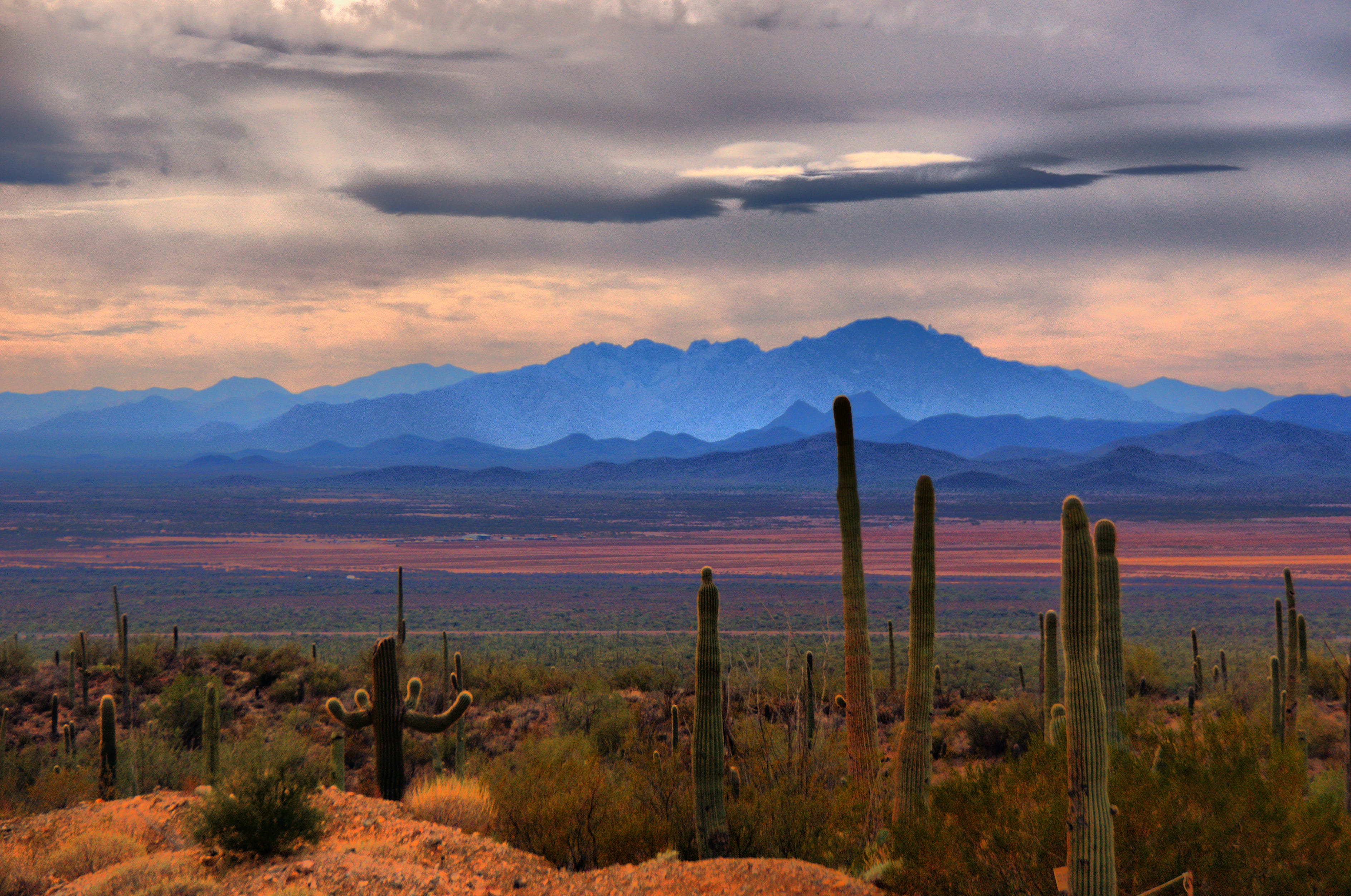
Yet as adaptable as they were, Sonoran Desert toads were not prepared for the onslaught of psychedelic interest. Humans are nimbler than other predators, with far greater appetites. Whether the toads hopped, scrambled or froze, hoping to evade detection, their new pursuers could easily scoop them up and press on their glands. While toad smoking remained a fringe activity, this was a rare experience for the animals, and the rest went on with their lives—mating, feeding, hiding out from the sun. This fragile balance began to shift when the psychedelic practitioner Octavio Rettig was introduced to the medicine in 2006. With Dr. Gerry by his side, he set about milking thousands of toads each summer, amassing kilograms of dried secretion. “Octavio is simply unstoppable,” a practitioner who went out collecting with him in 2014 recalled, “even enthusiastically doing jumping jacks between toad milkings.”
The restricted habitat of the toad, an endemic species found nowhere else on earth, meant that the entire world’s supply had to be sourced from the Sonoran Desert. As demand for the medicine exploded, a new economy took shape to provide it. People could catch toads in Arizona, but the epicenter was in Sonora, which itself was in the midst of a violent transformation. In 2006, the Mexican government had deployed military troops to fight narcotraffickers, who smuggled cocaine, marijuana and methamphetamine worth billions of dollars each year to the U.S. The cartels responded by professionalizing their security forces, acquiring AK-47s and mounted machine guns for shooting down helicopters. Mexico’s drug wars intensified, and the national homicide rate tripled over the next five years. Vast areas of Sonora became no-go zones, and people who visited risked their lives.
This landscape of excessive violence also harbored the toad, an animal in demand globally for spiritual experiences and inner healing—including from addiction to the very drugs being trafficked. A collision between these disparate worlds seemed all but inevitable. In 2016, Dean Jefferys, the founder of a Facebook group about toad smoking, spent several weeks in Mexico, shooting footage for a documentary. Jefferys is the epitome of a New Age elder, with salt-streaked hair and a white beard; he usually wears colorful unbuttoned shirts. One night, while driving around, searching for toads, he was pulled over by armed men. “The cartels have a whole network,” he recalled. “As soon as a strange car comes in, people are notified. I was staring down the barrel of a gun.” Just a few weeks earlier, he reported, an unsuspecting woman from the United States had been kidnapped while looking for toads and was held for several days. In a Facebook post, Jefferys warned that the desert “is definitely not a place where you can just go and find some toads.”
As Sonora became more dangerous, demand for the medicine only rose. Collecting toads had become perilous, creating an opportunity for local intermediaries who could move through toad habitats without arousing suspicion. One of the first to assume this role was a burly resident of Hermosillo named Carlos Barraza who, around 2014, began supplying buyers in Mexico and abroad. Barraza has a circular face and rounded shoulders, giving him a faintly toadlike appearance. According to his rivals, he has a ruthless disposition. He soon rose to become one of the world’s biggest toad medicine suppliers.
In the early days of this operation, Barraza began selling toad to Mario Garnier, a former TV producer from Mexico City. Garnier had been introduced to toad smoking a few years earlier and “left everything behind”—his job, a voiceover studio, a production school where he taught—to begin what he later described as a spiritual journey with the medicine. He began serving toad and sourcing medicine for people in his network; one of his friends, a former corporate lawyer, was soon hosting as many as a thousand sessions a year. Garnier went from buying ten grams a month from Barraza (enough for several hundred strong doses) to ten times as much. But when Garnier tried to negotiate the price down, Barraza refused, and their relationship soured.
In Garnier’s telling, Barraza was a “thug” who was seizing control of the toad market by force. “He was very violent,” Garnier said, without elaborating further. (Others described Barraza to me in similar ways.) Garnier himself acknowledges experiencing a kind of mania at the time, “wanting to save the world with toad medicine.” The God molecule had found another emissary. “I was in the Messiah state,” Garnier said.
In 2015, seeking new suppliers, he set off deeper into Sonora, where the toads were even more plentiful. He met people who had formerly caught toads for Octavio. “He paid them with bottles of liquor,” Garnier told me. “They were giving him the medicine without knowing what it was.” (Octavio denies this.) Garnier had formed relationships with practitioners in Europe and wanted to set them up with collectors in Sonora. Large orders started coming in—from Spain, the Netherlands, Germany. “I built the medicine bridge,” Garnier said. “Then people became greedy.” Later, in a text message, he seemed to acknowledge his own complicity. “The molecule is like the ring of Tolkien,” he wrote, using a metaphor I’d already heard from others. “Creates greediness. Thirst of power.”
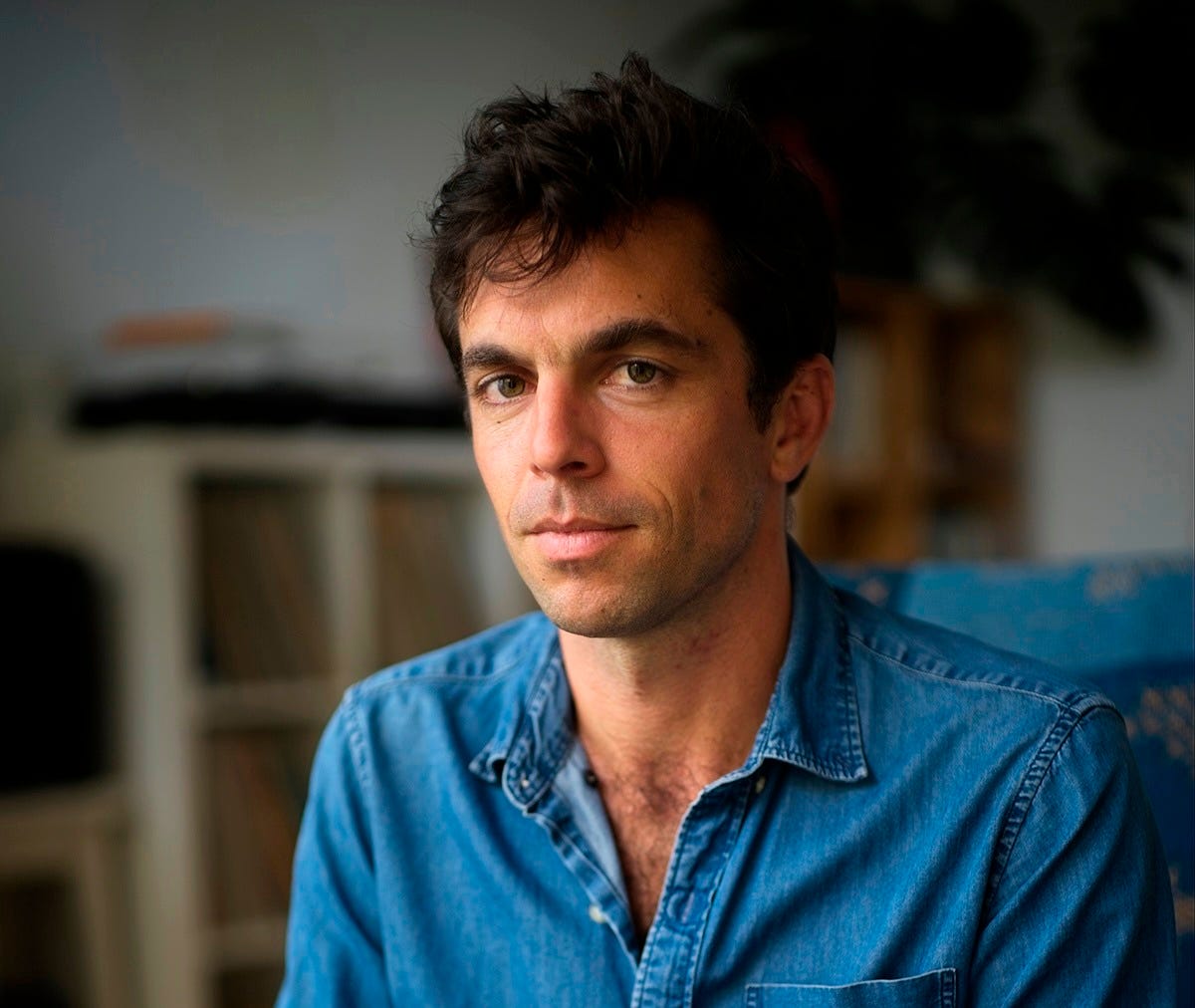

Kimon de Greef has written for The New Yorker, New York, The New York Times, The Guardian, and other publications. His first book, co-authored with Shuhood Abader, is Poacher: Confessions from the Abalone Underworld. He lives in Cape Town.
From THE EGO TRIP: Psychedelic Toads, A Trail of Deaths, and the Guru Who Peddled Transcendence. Reprinted by permission of Doubleday, an imprint of the Knopf Doubleday Publishing Group, a division of Penguin Random House. Copyright © 2026 by Kimon de Greef.
 |
|
Thank you for writing this! If you create a toad society I will join. I am willing to put myself between the toads & the psychedelic bros.
thank you for writing this; I can't wait to read the book. my grandparents lived in the Arizona side of the Sonoran desert, and it's a place close to my heart. 🌵